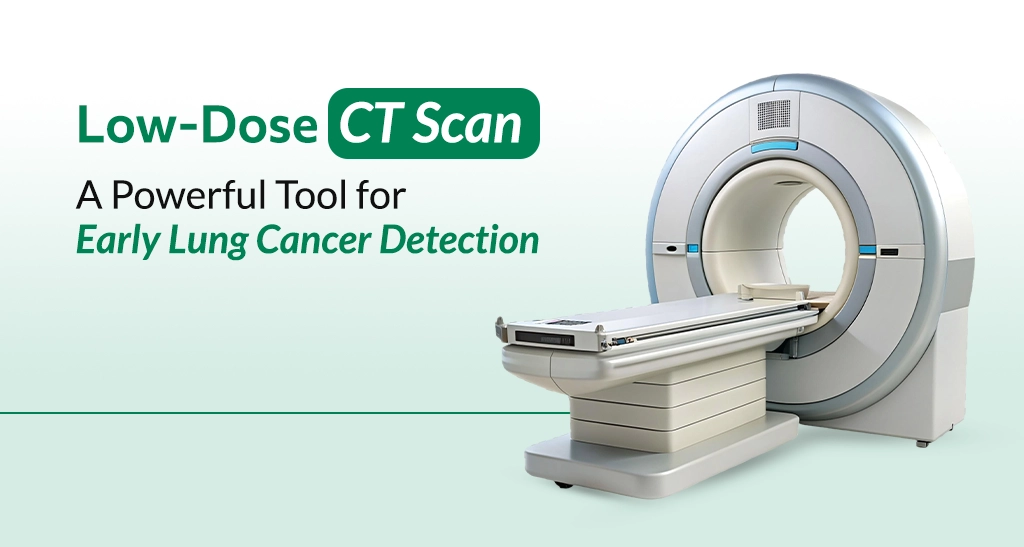
Lung cancer cases are rising steadily at present. In India, lung cancer accounts for around 5.9% of all cancers, and is responsible for 8.1% of all cancer-related deaths. Globally, lung cancer cases have reached around 2.4 million, with approximately 1.8 million deaths reported annually. One of the main reasons for the high mortality rate is that most of these cases (around 80%) are detected only in advanced stages, making treatment outcomes bleak.
Lung cancer is notorious for developing silently, but preventive diagnostics will let you stay one step ahead with early detection and timely treatment for a better prognosis. One of the primary tools used for lung cancer screening is the Low-dose CT scan or LDCT.
Let’s understand in detail why early screening is essential for lung cancer and how the low-dose CT scan works to detect the same.
Why Early Screening Matters In Lung Cancer Detection?
To understand the profound necessity of early lung cancer screening, it is crucial to understand the physiology of cancer cells and how these cells spread unnoticed in the body so quickly.
The primary cause of lung cancer is long-term exposure to carcinogens, primarily from tobacco smoke. This damage progresses in four phases:
- Cellular damage – Carcinogens damage cell DNA in the airways.
- Genetic mutations – Over the years, gene mutations may accumulate, triggering the oncogenes.
- Uncontrolled cell growth – Normal cells get transformed into malignant cells, multiplies rapidly to form tumour nodule.
- Silent Growth phase – In early stages, the small nodule hidden inside the vast lung tissue doesn’t pose any problems or show any symptoms and continues to grow unchecked.
By the time symptoms like persistent cough or breathlessness develop, the cancer has already grown or spread beyond treatable circumstances.
It is highly important that the screening method used is sensitive enough to detect the small nodules, located deep within the tissue. This ensures that cancer is caught during this early window, giving the patient a fighting chance at complete recovery.
Why LDCT is better than Chest X-rays for Early Lung Cancer Screening?
Older screening methods like chest X-rays provide standard two-dimensional shadow grams that are not sensitive enough to detect tiny cancerous nodules, especially when embedded deep in the lung tissue. Here’s where the high-resolution, three-dimensional detailing of a low-dose CT scan shows its advantage in effective early cancer screening. Modern LDCTs can detect nodules as small as 3-5 mm. With 80% lower radiation than a standard CT scan, LDCT is a safer, more sensitive option for cancer screening.
Who Should Get A Low-Dose CT Scan?
Low-dose CT scan is recommended for those who fall under the lung cancer risk category primarily due to their age and smoking habits. Low-dose CT is recommended for individuals meeting the following criteria:
- Age: Individuals aged between 50-80 years.
- Smoking History: Current smokers or those who have quit in the last 15 years.
- Smoking Frequency: Those with a 20-pack (1 pack/day for 20 years) history of smoking.
- Secondary smoke: Those who have prolonged exposure to second-hand smoke.
Since smoking is a primary cause of lung cancer, early lung cancer screening is non-negotiable for all smokers. Sometimes there are cases of non-tobacco related lung cancers as well. This may be seen in individuals who:
- Are exposed to asbestos and other chemical carcinogens at their workplace.
- Have a family history of lung cancer.
- Have severe lung infections.
- Use coal for cooking or heating in poorly ventilated spaces.
Individuals falling into the risk factor groups can easily get an LDCT done without worrying about excess radiation exposure as they use very low amounts of radiation when compared to regular CT scans.
What Happens During A Low-Dose CT Scan?
- No pre-preparations are needed for an LDCT. Wear loose, comfortable clothing and ensure to remove any metal jewelry or accessories before the test. Also, inform your technician about any medications that you may be taking.
- You will be asked to lie flat on the scanner table. Correct positioning is very important for accurate scanning.
- Holding your breath briefly when asked will minimise movement and give clear images of your lungs.
- Multiple images are captured by the scanner from various angles. These will be compiled to give a detailed picture of your lungs.
- The scan is very time-efficient and takes only a few minutes.
- The radiologist and technician then overview the images and interpret the results.
Deciphering the LDCT Results:
The results of an LDCT scan are reported using a standardised system called the Lung-RADS classification.
- Lung-RADS Category 1 –> Negative.
- Lung-RADS Category 2 –> Benign, but not a cause of concern.
- Lung-RADS Category 3 –> Benign, but cause of concern.
- Lung-RADS Category 4 –> Suspicious.
A Lung-RADS 4 category result doesn’t automatically mean a cancer diagnosis. It just implies that certain suspicious nodules have been observed and that it warrants further investigations like a PET- scan or biopsy before arriving at a conclusive diagnosis.
To Summarise:
For years, lung cancer has been a feared disease because of poor prognosis associated with late-stage detection. Low-dose CT scans have revolutionized lung cancer screening by enabling detection of very small nodules before symptoms emerge, leading to effective treatment. It is a highly sensitive scan that uses very minimal radiation to detect even the tiny nodules, offering the potential for a complete cure with surgery or radiation therapy.
If you are falling into the risk category of smokers with an advanced age, take up the option to undergo this simple, quick, and painless scan at your next health checkup. This one step could probably save your life.