
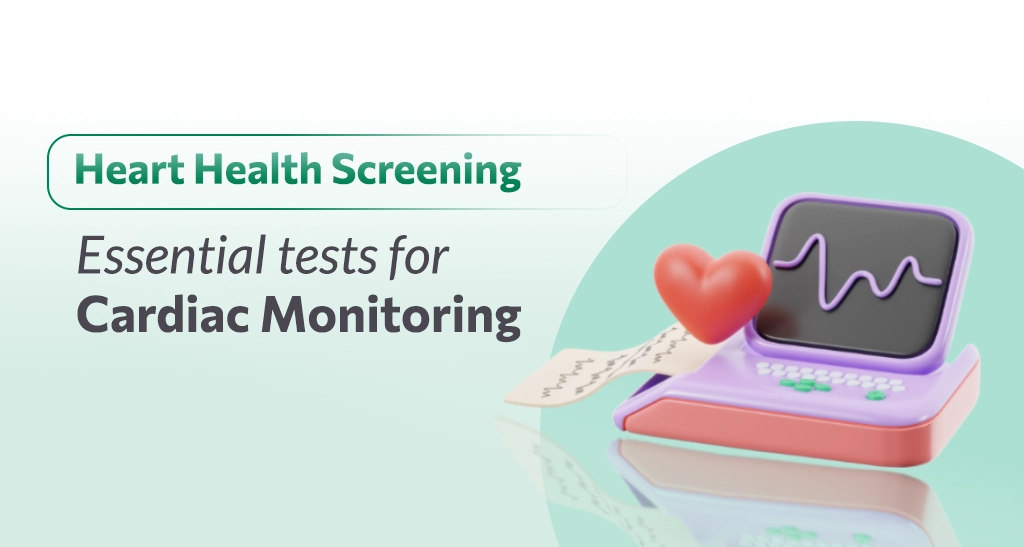
Your heart works tirelessly 24/7 – never clocks out, never asks for a break. Because your heart works hard to keep you going, scheduling a regular health checkup to help it remain in its best condition is a smart choice.
A research study published in the NCBI highlights that nearly 11% of the Indian population live with cardiovascular diseases. Heart disease is well- known for developing silently – plaque can quietly build up in your arteries for years without showing any symptoms. By the time you start experiencing chest pain or shortness of breath, damage may have already occurred within.
The promising news is that many of the cardiac events are preventable or at least predictable with the right screening methods. Regular cardiac screening helps us to identify risk factors and early signs before they progressively become difficult to treat.
In this guide, we have simplified heart health screening for you – including warning signs to keep an eye on, best heart health tests to undertake, tips on choosing the tests, and why accuracy is important in cardiac monitoring.
Who Should Get Screened and When?
Cardiac health screening should be availed by individuals with the following risk factors:
- Age: Men above 40 and women above 50 are more susceptible.
- Genetics: Strong family history of cardiovascular disease.
- Obesity: Poor weight management adds to cardiovascular risk.
- Sedentary Lifestyle: Being inactive limits circulation, increasing the risk.
- Smoking: Blocks arteries and puts them at a high risk.
- Lifestyle diseases like Hypertension and Diabetes.
- Anyone observing symptoms of heart disease.
How To Care For Your Heart Based on Your Age?
Adults in different age categories need to monitor heart health as advised. A simple timeline you can follow is mentioned below:
- Age 20 – 40: Monitor baseline blood pressure and cholesterol levels every few years. Regular checks are a must for those with family history.
- Age 40 – 65: Cardiovascular risk goes up with age; hence, more frequent assessments are needed. Special focus on those with diabetes, hypertension, obesity, and smoking history.
- Age 65 and Above: Annual or more frequent monitoring needed as the risk factors keep rising with age.
Screening frequency can vary from person to person. For example, an individual in their 30’s with a strong family history of heart disease may need to screen more often than a person in their 50’s with no family history.
Heart Disease: 5 Warning Signs to Watch Out For:
Cardiac disease is notorious for creeping up silently. But sometimes, you may observe subtle signs that may indicate that not all is well with your heart.
These are the main 5 warning signs you need to watch out for:
- Chest Pain or Tightness: A feeling of heaviness or pressure in the chest with stress or exertion.
- Shortness of Breath: Difficulty in breathing even during minimal activity.
- Irregular Heartbeat or Palpitations: A racing or pounding sensation that may indicate arrhythmia.
- Dizziness or Fainting: Feeling faint or dizzy due to poor circulation and low oxygen levels.
- Persistent Fatigue: Constant tiredness without any reason is a strong sign of underlying cardiac issues.
Other symptoms worth noting include swelling in the hands and feet, a radiating pain along the arm, back, or jaw, cold sweats, and nausea. Anyone experiencing a combination of these symptoms must seek immediate evaluation.
What Are the Best Heart Health Screening Tests?
There is no single best heart health screening test that will give all the answers to your cardiac condition. Analyzing multiple parameters based on your risk factors will give a broader picture of your heart health:
Basic Heart Health Screening Tests:
- Blood Pressure Measurement: Quick and non-invasive procedure. Readings higher than 130/80 mmHg are considered a cardiac risk.
- Lipid Panel: To check total cholesterol, LDL, HDL, VLDL, Triglycerides. High LDL may cause arterial blocks, increase heart risk.
- Blood Glucose or HbA1c: Screens for prediabetes and diabetes; both high risk cardiac factors.
Diagnostic Imaging Tests:
- Electrocardiogram (ECG): Monitors heart rate, detects arrhythmias, heart attack occurrences, electrical conduction issues.
- Echocardiogram: An ultrasound of the heart showing heart structure, function, and pumping efficiency.
- Stress Test: Evaluates heart function under physical exertion or medically simulated stress.
- Coronary CT Calcium Score: Measures the buildup of calcium in the arteries, helps assess blockages.
Advanced Screening:
- Cardiac CT Angiography or Coronary Angiograph: Mildly invasive procedure to directly visualize arterial blockages. Especially preferred for immediate treatment.
- MRI Heart: Provides detailed imaging of the heart, showing structural defects, myocarditis.
- Cardiac Biomarkers: Troponin – to detect heart attacks, BNP – to detect heart failure, hs-CRP – to detect inflammation.
How To Choose the Right Test?
Choosing the right heart health screening depends on your cardiac health’s starting point.
- No symptoms, no risk factors: Basic analysis – blood pressure, blood glucose or HbA1c, and lipid panel.
- No symptoms, risk factors present: A Coronary calcium score along with few more basic parameters.
- Symptoms observed: Complete diagnostic testing – ECG, Echo, Stress test, along with blood panel.
- Known cardiac condition: CT angiography or Coronary angiograph, mainly in case of suspected blockage.
- Suspected emergency event: Cardiac biomarkers like troponin, BNP, and ECG ensure rapid diagnosis in an emergency.
Why Accuracy Matters in Cardiac Testing?
When it comes to heart health screening, accuracy is non-negotiable – here’s why:
- If the test is too sensitive, it may lead to unwanted alarms, follow up tests, and additional cost.
- If the test is insensitive and cannot pick up the subtle inconsistencies, then the real risk goes undetected; treatment gets delayed until it turns into an emergency.
- The accuracy and quality of the tests may vary due to equipment used, technician skills, and result interpretation.
- Risk cannot be assessed based on a single test result. Only multiple parameters can give us the complete picture.
- Factors like timing and preparation may affect test results. For instance, fasting before a lipid analysis.
Test accuracy plays a direct role in patient care – how correctly the results are interpreted determines whether the patient will receive the requisite timely treatment, or if they leave falsely reassured while genuinely needing medical attention. This confusion can be avoided by choosing accredited labs for testing, seeking guidance from experienced medical personnel, and doing the required follow-up tests for clarity.
The Bottom Line on Heart Health:
Heart health screening tests are not the same for all. It starts with basic routine tests and changes subjectively based on your age, family history, and lifestyle. While blood pressure and cholesterol levels reveal the broader aspect, ECG, Echo, Stress tests dig deeper. Advanced imaging like MRI Scan, and blood biomarkers are analyzed when the screening demands a more precise approach.
Don’t wait for the symptoms to appear to undergo cardiac screening. Based on your age and other risk factors, schedule regular health checkups so that you can catch heart disease early, when it is most easily treatable.